Turn enquiries into orders
Help the buyer say what size they need
Many buyers know how much husk or coal they burn, not how many tonnes of steam they need. The estimator on your enquiry form turns either their fuel use or their heat load into steam at their pressure, and suggests the next standard size with a margin in hand.
- From the fuel they burn today, or from their process heat load
- Steam table enthalpy at the buyer’s working pressure
- The next standard size with 10% in hand, filled in for them
- Typical calorific values for husk, wood, briquettes, coal, oil, gas and power
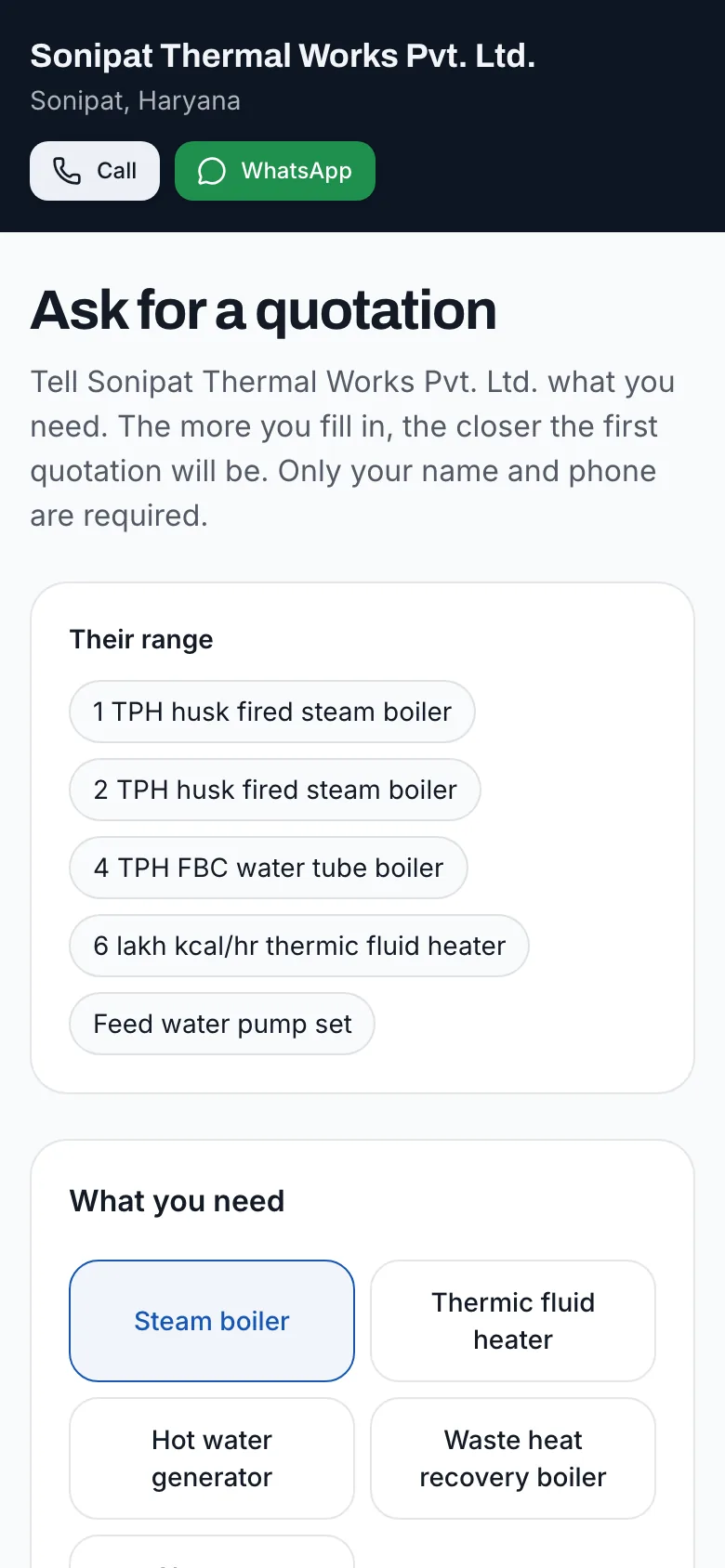
Sizing and fuel cost estimator
How it works
The buyer opens your enquiry link
Next to capacity, a link reads “Not sure? Estimate it”.
They enter what they know
Either the fuel they burn today and how much an hour, or their process heat load in kcal/hr.
They see the steam and a size
Steam at their working pressure, and the next standard size with 10% in hand. One tap puts it in the form.
Your engineer checks it
The enquiry shows the capacity they chose and what they told you, so the first call confirms instead of starts from zero.
Who it's for
Makers whose first call with a new buyer is spent working out what size they need, and whose quotations are often for the wrong capacity because the buyer guessed. It fits plants replacing an old boiler, which know their fuel bill better than their steam load.
Why it matters
An enquiry that says “need boiler, urgent” is a phone call before it is a quotation. An enquiry that says “525 kg/hr of rice husk, 10.5 kg/cm², parboiling, about 2.5 TPH” can be priced the same day. The estimator gives buyers a sensible number to start from, and gives your engineer the inputs behind it, so the conversation starts where it should. It helps the buyer too. A plant that has only ever bought one boiler may not know that its old 3 TPH boiler was rated from and at 100 °C, or that warmer feed water changes the answer. Seeing the arithmetic gives them confidence in the size, and in the maker who showed it to them.
What's included
Steam table based
Enthalpy of saturated steam at the working pressure, less the feed water’s, from the standard steam table.
Ten fuels
Rice husk, wood, briquettes, Indian and imported coal, furnace oil, diesel, PNG, LPG and electricity, with typical calorific values and efficiencies.
Standard sizes
Suggests the next size makers commonly build, from 300 kg/hr to 30 TPH.
Clear that it is an estimate
The form says the maker sizes the boiler on the real load: it starts the conversation, it does not replace it.
From and at 100 °C, explained
The guide that goes with it explains actual output against the from-and-at-100 °C rating, so buyers comparing offers compare like with like.
FAQ
Questions owners ask
- How accurate is the estimate?
- It uses the steam table and typical fuel values and efficiencies, so it is close enough to start a quotation. Fuel quality varies lot to lot, which is why your engineer confirms the size before the final offer.
- Can buyers compare fuel costs?
- The guide to the cost of a tonne of steam walks through the same arithmetic for each fuel. The estimator on the form sticks to sizing, so the enquiry stays short.
- Can I change the fuel values?
- The values are typical figures for Indian fuels. If your region’s husk or coal runs very different, tell us and we will add a note to your form.
- Why does the estimator add 10%?
- A boiler running flat out has nothing in hand for fuel that is wetter than usual, fouling between cleanings, or a small addition to the process. About 10% over the steady peak covers those without the boiler running at low load the rest of the time.
Guides to go deeper
All guides
How to Size an Industrial Boiler: Steam Load, Pressure and TPH
Work out the steam load from your process, your heat load or the fuel you burn today, pick the working pressure, and choose a boiler size with sensible margin.
4 min read
What a Tonne of Steam Costs on Husk, Coal, Briquettes, Oil, Gas and Power
How to work out the fuel cost of a tonne of steam for rice husk, wood, briquettes, coal, furnace oil, diesel, PNG, LPG and electricity, with a worked table.
4 min read
Turn enquiries into orders